Back
Copy
Share
Like
market
The reason why choosing a flagship store location based on intuition can lead to disaster.
The reason why choosing a flagship store location based on intuition can lead to disaster.
The reason why choosing a flagship store location based on intuition can lead to disaster.
The Top Priority for Flagship Locations, According to 31 Experts, is Market Scale Followed by Foot Traffic, with Interior Design Ranking Significantly Lower; Furthermore, the Definition of a "Prime Spot" Varies by Sector: Sports Prioritizes Façade, SPA Focuses on Cost Efficiency, and General Retail Values Brand Neighboring and Clustering Synergy.
The Top Priority for Flagship Locations, According to 31 Experts, is Market Scale Followed by Foot Traffic, with Interior Design Ranking Significantly Lower; Furthermore, the Definition of a "Prime Spot" Varies by Sector: Sports Prioritizes Façade, SPA Focuses on Cost Efficiency, and General Retail Values Brand Neighboring and Clustering Synergy.
The Top Priority for Flagship Locations, According to 31 Experts, is Market Scale Followed by Foot Traffic, with Interior Design Ranking Significantly Lower; Furthermore, the Definition of a "Prime Spot" Varies by Sector: Sports Prioritizes Façade, SPA Focuses on Cost Efficiency, and General Retail Values Brand Neighboring and Clustering Synergy.
Article Highlights
"Market Power Over Site Design"—Macro-Environment as the Primary Driver: The success or failure of a flagship store is determined by macro-environmental indicators—specifically Market Scale and Foot Traffic—which exert more than twice the influence of spatial characteristics like interior design or internal layout.
Sector-Specific Priorities: Defining the "Prime Spot": Experiential sports brands stake everything on Façade Length (Street Frontage) and Floor Plate size, while high-turnover SPA brands prioritize Business Viability and low fixed costs. General retail sectors, meanwhile, focus on Tenant Mix (Clustering Synergy) and proximity to public transportation.
Bridging the "Vision Gap" Between Executives and Consultants: To reconcile the divergence between internal expansion managers, who focus on operational efficiency and ROI, and external consultants, who emphasize visibility and PR value, success requires Rigorous Financial Execution backed by concrete revenue data.
Even in the era of e-commerce dominance, global brands continue to establish massive flagship stores in the heart of Seoul. The reason is clear: these are strategic flagships designed to immerse consumers in the brand experience rather than merely drive transactions. However, many brands exit the market after a flashy opening, burdened by exorbitant rents and fit-out costs. To understand what separates successful flagship locations from failures, we analyzed data derived from the "inner circles" of 31 industry experts.
Methodology
These insights were distilled through a systematic analysis of voices from veterans in the field. First, we conducted Focus Group Interviews (FGI) and brainstorming sessions with five experts (with 6+ years of experience), including expansion managers from global sports brands and real estate consultants, to establish core evaluation criteria.
Subsequently, an in-depth survey was conducted with 31 specialists, including expansion leads from 16 brands currently operating flagships in Korea and top-tier consultants. This group boasts an average of 10.6 years in the industry and 17.6 flagship launches each. To ensure objectivity and reliability, we utilized the Analytic Hierarchy Process (AHP) to reflect logical human thought processes, combined with Fuzzy Theory to mathematically handle ambiguous qualitative judgments.
The Experts' Golden Rules for Site Selection
Because flagship stores symbolize the brand, location importance is far higher than for standard retail units. Experts evaluated sites across five major pillars: Environment, Business Viability, Location, Consumer Profile, and Spatial Characteristics. The results showed that Environmental Characteristics—which represent the fundamental "weight class" of a trade area—are more critical than interior fit-outs.
Market Scale (Overall Rank: 1st | The overall reach and retail sales volume of the district are the most dominant factors. |
|---|---|
Foot Traffic (Overall Rank: 2nd) | The absolute number of people passing the storefront is key to securing potential customers. |
Business Viability (Overall Rank: 3rd) | Aesthetics aren't everything. Calculating the Return on Investment (ROI) takes precedence over the store's physical shape. |
Site Position (Overall Rank: 4th) | Securing a spot with superior accessibility and optimal flow within the trade area. |
Fixed Cost Sustainability (Overall Rank: 5th) | Determining whether rent and CAM (Common Area Maintenance) fees are manageable relative to projected revenue. |
Sector-Specific Priorities
The definition of a "prime location" shifts dramatically depending on the category of products a brand sells. Sportswear and multi-brand footwear retailers prefer "Grand Stages." To properly implement immersive experiential zones, they are significantly more sensitive than other sectors to Floor Plate size (individual floor area) and securing Façade Length (street frontage) for brand promotion.
On the other hand, SPA brands like Zara and H&M "hit the calculator" even more aggressively. Since high inventory turnover is the lifeblood of their model, they prioritize Business Viability, Low Fixed Costs, and Omnichannel Marketing Efficiency linked with their online operations as their top considerations.
For General Retail sectors such as cosmetics, home appliances, and character brands, "picking the right neighbors" is paramount. To ensure Clustering Synergy, they meticulously verify the Tenant Mix (which brands are gathered nearby) and the density of competitors. Furthermore, they judge locations with convenient access to public transportation as the optimal sites for efficient operational logistics.

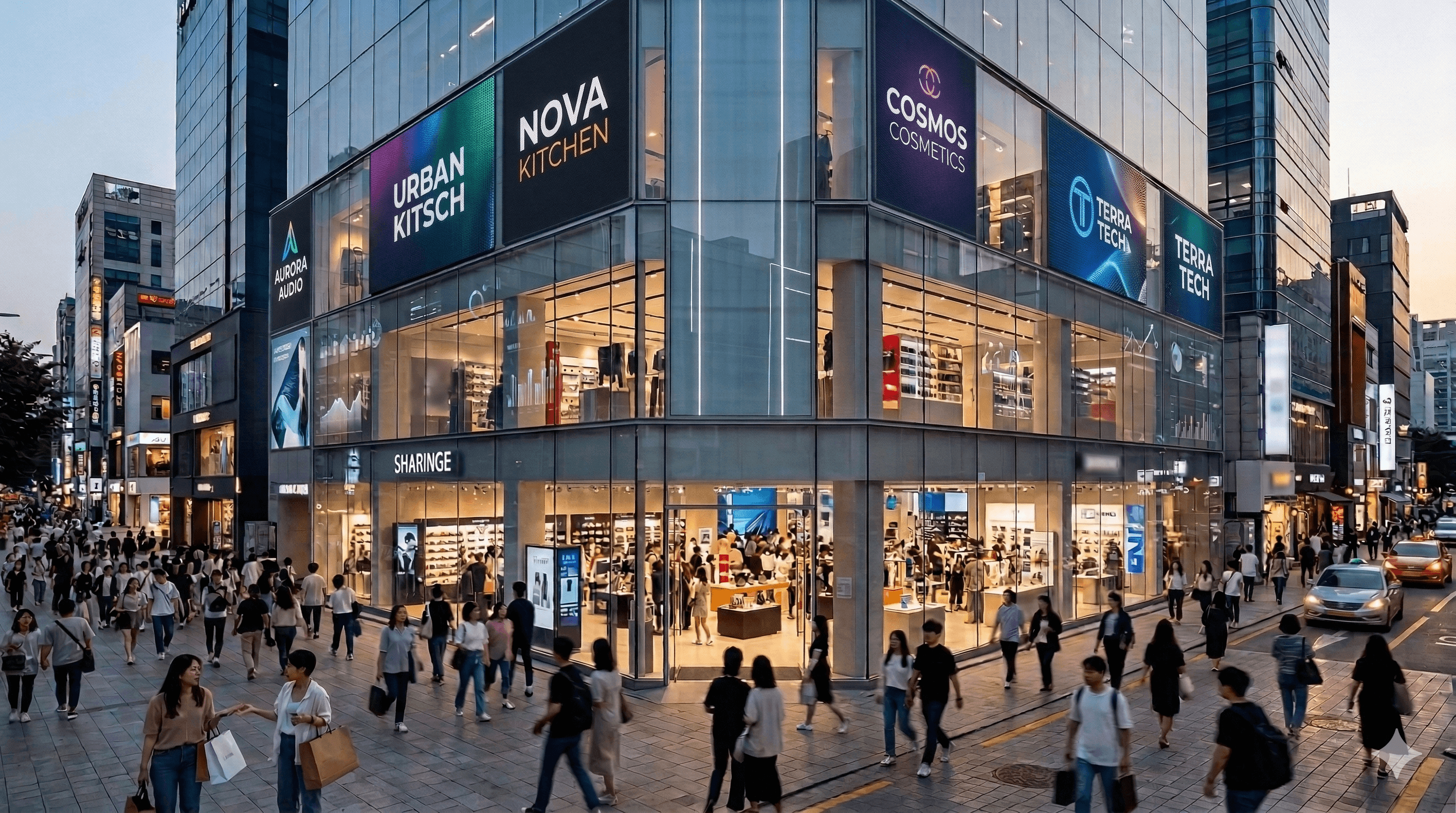
Source: The image was generated by AI for illustrative purposes
Industry | Points |
|---|---|
Sports | For sports brands like Nike or Adidas, implementing experiential zones is crucial. Therefore, they are more sensitive than other industries to securing Floor Plate size and Façade Length for brand promotion. |
SPA | For SPA brands like Zara and H&M, high inventory turnover is the core driver. They prioritize Business Viability, Low Fixed Costs, and Marketing Efficiency integrated with online channels. |
Retail | For general retail such as cosmetics, appliances, and character brands, they focus heavily on the Tenant Mix (surrounding brands) to ensure foot traffic synergy and prioritize Accessibility to public transportation, such as subway stations. |
Executive Leadership vs. External Consultants: A Case of "Same Site, Different Vision"
While internal expansion leads and real estate consultants share a common goal, their perspectives often diverge. Ultimately, providing concrete revenue data and a clear strategic direction is the most critical factor in finalizing a flagship location.
The intriguing part of the process is how internal brand expansion managers and external consultants can look at the exact same property yet prioritize entirely different elements. Internal Brand Managers are the "Realists" who must bear the responsibility of day-to-day operations. Consequently, they react hyper-sensitively to Business Viability, Fixed-Cost Sustainability, and CAPEX (Capital Expenditure)—essentially the real-time cash flow of the project.
In contrast, External Real Estate Consultants act as "Visionaries" who place high premiums on the latent potential of a site. They tend to prioritize visual impact and PR value, such as the district’s overall spending power, the building's visibility, and the Façade Length required to create a grand street presence.
For a negotiation to be successful, a consultant cannot simply present a "pretty building" to a brand executive. They must present concrete revenue data that proves why that specific location will be profitable. In the world of high-stakes retail, a brand cannot be persuaded by "nice renderings" alone.
Practical Pro-Tips for a Successful Launch
The practical strategies derived from global sportswear brand case studies are definitive. Because a flagship store represents a massive, long-term capital commitment, at least eight essential metrics must be rigorously evaluated. Factors such as Market Scale, Foot Traffic, Business Viability, Site Position, and Spending Power are absolute non-negotiables. Beyond these, an optimal decision can only be reached when Floor Plate size, Surrounding Environment, and Fixed-Cost Sustainability also receive a "fit" assessment.
Ultimately, the success of a flagship store is determined more by the macro-characteristics of the trade area and its collective "draw" than by the aesthetic sophistication of the building itself. The core strategy for flagship success lies in preemptively securing a superior position over competitors within an iconic, high-traffic district and executing this within a stable, sustainable cost structure.
Market Dominance Overpowers Individual Site Conditions
The ultimate arbiter of a flagship store's success is not its physical attributes, such as lavish interiors or internal architectural design. Industry experts recognize macro-characteristics of the trade area and its collective "draw" as far more critical determinants in the site selection process than the internal utility of the space. In fact, empirical analysis shows that the importance of "Environmental Characteristics" (the market's fundamental weight class) is more than double that of "Spatial Characteristics." This is because a flagship store transcends its role as a mere sales outlet to function as a landmark that symbolizes the brand’s identity.
To execute a successful launch, it is essential to preemptively secure a superior position over competitors within an iconic, high-traffic district. Market Scale and Foot Traffic remain the unshakeable No. 1 and No. 2 indicators, as the resulting "aggregation power" serves as the foundation for communicating brand identity. However, even the most prestigious location will lead to failure if the cost structure is unsustainable. The reason experts ranked Business Viability and Fixed-Cost Sustainability as top-tier factors is that flagships require massive upfront CAPEX; long-term branding is only possible when the project is executed within a stable and sustainable financial framework.
Ultimately, the essence of flagship strategy lies in the synergy between Macro Market Analysis and Rigorous Financial Execution. Rather than getting lost in the minor details of individual spaces, the only path to victory in the retail real estate market is to first read the "Great Tide" of the trade area and implement a sustainable business model on top of it.
Even in the era of e-commerce dominance, global brands continue to establish massive flagship stores in the heart of Seoul. The reason is clear: these are strategic flagships designed to immerse consumers in the brand experience rather than merely drive transactions. However, many brands exit the market after a flashy opening, burdened by exorbitant rents and fit-out costs. To understand what separates successful flagship locations from failures, we analyzed data derived from the "inner circles" of 31 industry experts.
Methodology
These insights were distilled through a systematic analysis of voices from veterans in the field. First, we conducted Focus Group Interviews (FGI) and brainstorming sessions with five experts (with 6+ years of experience), including expansion managers from global sports brands and real estate consultants, to establish core evaluation criteria.
Subsequently, an in-depth survey was conducted with 31 specialists, including expansion leads from 16 brands currently operating flagships in Korea and top-tier consultants. This group boasts an average of 10.6 years in the industry and 17.6 flagship launches each. To ensure objectivity and reliability, we utilized the Analytic Hierarchy Process (AHP) to reflect logical human thought processes, combined with Fuzzy Theory to mathematically handle ambiguous qualitative judgments.
The Experts' Golden Rules for Site Selection
Because flagship stores symbolize the brand, location importance is far higher than for standard retail units. Experts evaluated sites across five major pillars: Environment, Business Viability, Location, Consumer Profile, and Spatial Characteristics. The results showed that Environmental Characteristics—which represent the fundamental "weight class" of a trade area—are more critical than interior fit-outs.
Market Scale (Overall Rank: 1st | The overall reach and retail sales volume of the district are the most dominant factors. |
|---|---|
Foot Traffic (Overall Rank: 2nd) | The absolute number of people passing the storefront is key to securing potential customers. |
Business Viability (Overall Rank: 3rd) | Aesthetics aren't everything. Calculating the Return on Investment (ROI) takes precedence over the store's physical shape. |
Site Position (Overall Rank: 4th) | Securing a spot with superior accessibility and optimal flow within the trade area. |
Fixed Cost Sustainability (Overall Rank: 5th) | Determining whether rent and CAM (Common Area Maintenance) fees are manageable relative to projected revenue. |
Sector-Specific Priorities
The definition of a "prime location" shifts dramatically depending on the category of products a brand sells. Sportswear and multi-brand footwear retailers prefer "Grand Stages." To properly implement immersive experiential zones, they are significantly more sensitive than other sectors to Floor Plate size (individual floor area) and securing Façade Length (street frontage) for brand promotion.
On the other hand, SPA brands like Zara and H&M "hit the calculator" even more aggressively. Since high inventory turnover is the lifeblood of their model, they prioritize Business Viability, Low Fixed Costs, and Omnichannel Marketing Efficiency linked with their online operations as their top considerations.
For General Retail sectors such as cosmetics, home appliances, and character brands, "picking the right neighbors" is paramount. To ensure Clustering Synergy, they meticulously verify the Tenant Mix (which brands are gathered nearby) and the density of competitors. Furthermore, they judge locations with convenient access to public transportation as the optimal sites for efficient operational logistics.
Source: The image was generated by AI for illustrative purposes
Industry | Points |
|---|---|
Sports | For sports brands like Nike or Adidas, implementing experiential zones is crucial. Therefore, they are more sensitive than other industries to securing Floor Plate size and Façade Length for brand promotion. |
SPA | For SPA brands like Zara and H&M, high inventory turnover is the core driver. They prioritize Business Viability, Low Fixed Costs, and Marketing Efficiency integrated with online channels. |
Retail | For general retail such as cosmetics, appliances, and character brands, they focus heavily on the Tenant Mix (surrounding brands) to ensure foot traffic synergy and prioritize Accessibility to public transportation, such as subway stations. |
Executive Leadership vs. External Consultants: A Case of "Same Site, Different Vision"
While internal expansion leads and real estate consultants share a common goal, their perspectives often diverge. Ultimately, providing concrete revenue data and a clear strategic direction is the most critical factor in finalizing a flagship location.
The intriguing part of the process is how internal brand expansion managers and external consultants can look at the exact same property yet prioritize entirely different elements. Internal Brand Managers are the "Realists" who must bear the responsibility of day-to-day operations. Consequently, they react hyper-sensitively to Business Viability, Fixed-Cost Sustainability, and CAPEX (Capital Expenditure)—essentially the real-time cash flow of the project.
In contrast, External Real Estate Consultants act as "Visionaries" who place high premiums on the latent potential of a site. They tend to prioritize visual impact and PR value, such as the district’s overall spending power, the building's visibility, and the Façade Length required to create a grand street presence.
For a negotiation to be successful, a consultant cannot simply present a "pretty building" to a brand executive. They must present concrete revenue data that proves why that specific location will be profitable. In the world of high-stakes retail, a brand cannot be persuaded by "nice renderings" alone.
Practical Pro-Tips for a Successful Launch
The practical strategies derived from global sportswear brand case studies are definitive. Because a flagship store represents a massive, long-term capital commitment, at least eight essential metrics must be rigorously evaluated. Factors such as Market Scale, Foot Traffic, Business Viability, Site Position, and Spending Power are absolute non-negotiables. Beyond these, an optimal decision can only be reached when Floor Plate size, Surrounding Environment, and Fixed-Cost Sustainability also receive a "fit" assessment.
Ultimately, the success of a flagship store is determined more by the macro-characteristics of the trade area and its collective "draw" than by the aesthetic sophistication of the building itself. The core strategy for flagship success lies in preemptively securing a superior position over competitors within an iconic, high-traffic district and executing this within a stable, sustainable cost structure.
Market Dominance Overpowers Individual Site Conditions
The ultimate arbiter of a flagship store's success is not its physical attributes, such as lavish interiors or internal architectural design. Industry experts recognize macro-characteristics of the trade area and its collective "draw" as far more critical determinants in the site selection process than the internal utility of the space. In fact, empirical analysis shows that the importance of "Environmental Characteristics" (the market's fundamental weight class) is more than double that of "Spatial Characteristics." This is because a flagship store transcends its role as a mere sales outlet to function as a landmark that symbolizes the brand’s identity.
To execute a successful launch, it is essential to preemptively secure a superior position over competitors within an iconic, high-traffic district. Market Scale and Foot Traffic remain the unshakeable No. 1 and No. 2 indicators, as the resulting "aggregation power" serves as the foundation for communicating brand identity. However, even the most prestigious location will lead to failure if the cost structure is unsustainable. The reason experts ranked Business Viability and Fixed-Cost Sustainability as top-tier factors is that flagships require massive upfront CAPEX; long-term branding is only possible when the project is executed within a stable and sustainable financial framework.
Ultimately, the essence of flagship strategy lies in the synergy between Macro Market Analysis and Rigorous Financial Execution. Rather than getting lost in the minor details of individual spaces, the only path to victory in the retail real estate market is to first read the "Great Tide" of the trade area and implement a sustainable business model on top of it.
More in
More in
market
market
market
Apr 2, 2026
Office Retail: No Longer the Sidekick
Beyond rental spaces, office retail determines the sophistication of an office.

market
Mar 8, 2026
A two-year tragedy tied up in permits and approvals—your brand must be different.
CBRE Retail-TNT's one-stop solution enables seamless global expansion.
Get the best of 'detail'
in your inbox, every month
Once a month, no spam
Get the best of 'detail'
in your inbox, every month
Once a month, no spam
Get the best of 'detail'
in your inbox, every month
Once a month, no spam